For museums, digital libraries and archives
Help visitors and researchers find what your catalogue search misses.
Search that understands questions asked in plain language — in Polish, English, Ukrainian, Belarusian and Russian — and leads straight to the object record in your catalogue. It runs alongside your existing system, without any changes to it.
What changes
Catalogue search expects titles and accession numbers. People ask differently.
Catalogue search matches words. Semantic search matches meaning, so it finds objects even when the person asking doesn't know the title, the artist's name or the terms used in the record.
Questions, not keywords
Ask the way you'd talk: about a subject, a motif, a period or a place. No need to guess how the catalogue field is worded.
Five languages, one catalogue
A question in Ukrainian or English finds objects described in Polish — without translating the whole catalogue.
Always linked to the record
Every result opens the object record in your own system. Descriptive answers are built from your descriptions and point to the records they come from.
Works on imperfect data
Sparse metadata, OCR errors, mixed languages. The same engine searches about 45,000 digitised archive documents.
The offer
One fixed price, four weeks, working search on your own data.
At the end of the pilot you have search that visitors can use and a report to base the decision on: ongoing hosting, or stopping there.
Pilot
Semantic search for your collection in 4 weeks
Included
- Connecting your collection via OAI-PMH, an API or an export (CSV, XML, JSON)
- Semantic search with results ranked by relevance, in Polish, English, Ukrainian, Belarusian and Russian
- A search page on your subdomain, or a module embedded in your institution's website
- Results that link to the object records in your catalogue
- Tuning the results against a list of hard questions prepared with your team
- Hosting and technical support throughout the pilot
- A final report: result quality, aggregated anonymous query statistics, recommendations
What your institution provides
- The address of a public API or OAI-PMH endpoint — or a one-off export of records
- One contact person from collections, documentation, digitisation or IT
- Two 45-minute online meetings: at the start and at handover
- A list of 20–30 questions visitors ask most often (I'll help prepare it)
Data and security
- Data and index on servers in Poland (Warsaw); traffic to the page goes through the Cloudflare network. On request, installed on your own infrastructure
- GDPR: a data processing agreement on request; the search page has no tracking cookies and no third-party analytics
- Your data is never used to train models. Search runs on open models on my own servers
- Rights to the data and descriptions stay with your institution; I delete my copy of the data when we finish and confirm it in writing
After the pilot: hosting and maintenance on a monthly subscription (collection updates, monitoring, fixes), or a handover for installation on your side.
With an estimated contract value below PLN 130,000 net, the Polish Public Procurement Law (Pzp) does not apply; your internal rules decide the procedure. Optional, quoted separately: short descriptive answers and an exhibition guide like the demo below. Descriptive answers use a commercial language model through an API (the provider is named in the contract); only public object descriptions and the question are sent, and the provider does not train on them.
How it runs
A demo first, then four weeks of work on your collection.
Before the pilot
Demo and a call
A free demo on your public data and a 20-minute call. The quote follows the call.
Week 1
Connect
I harvest the records and check metadata quality and description languages.
Week 2
Search
Indexing and a first version for your team to test.
Week 3
Test
Your team tries the hardest questions; I fix the ranking wherever results miss.
Week 4
Launch
Live on your domain, with a report and a decision on what's next.
Example
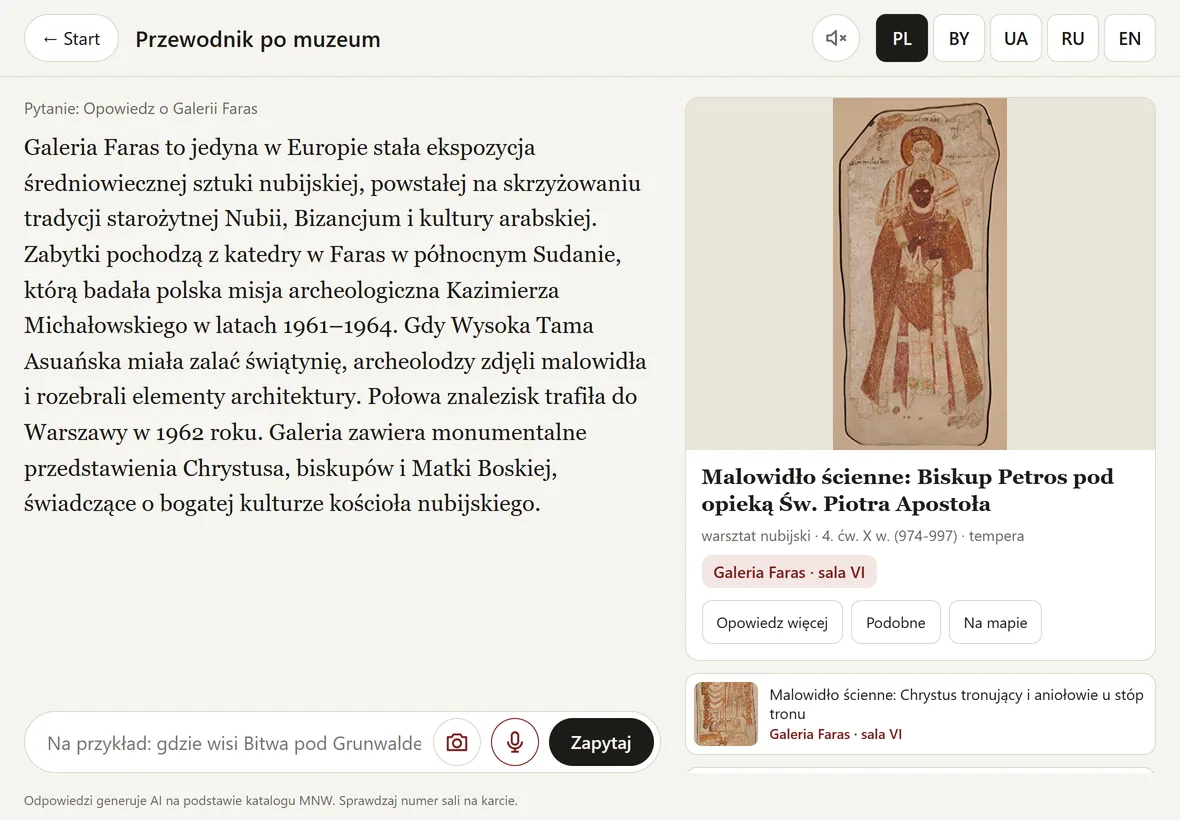
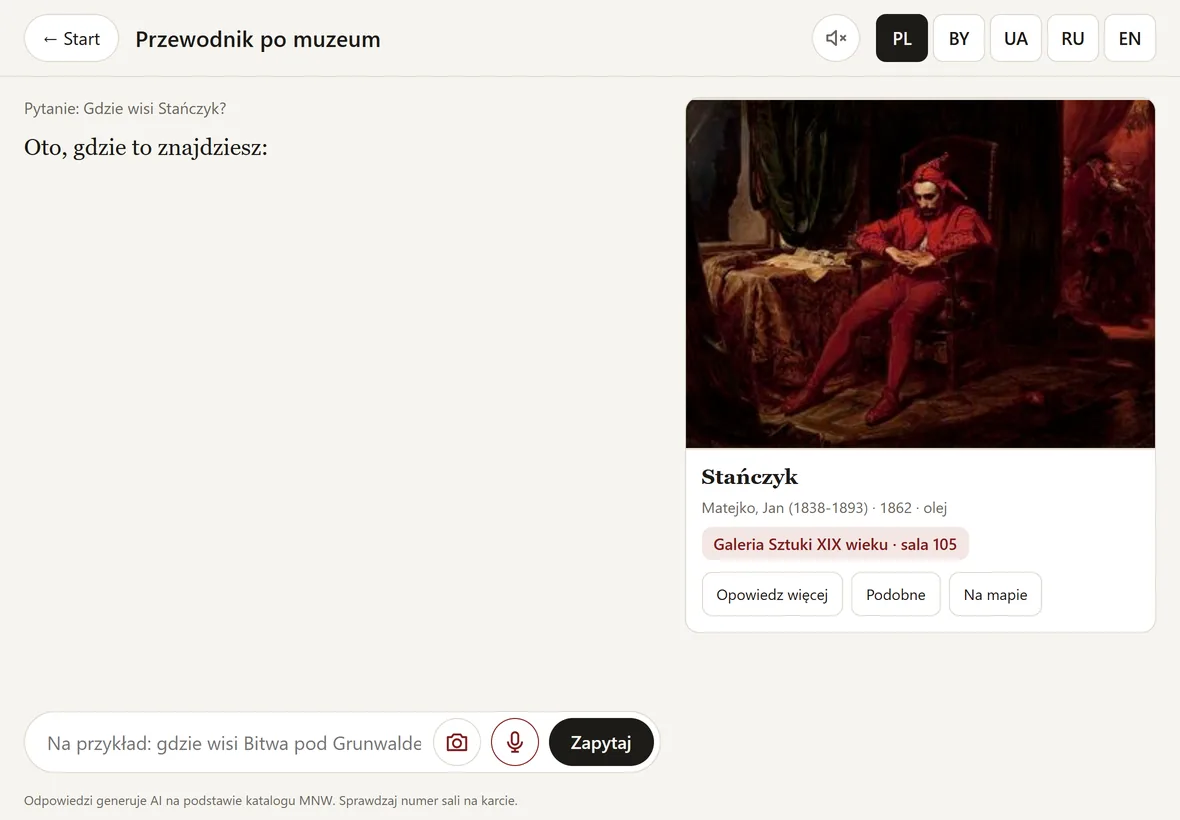
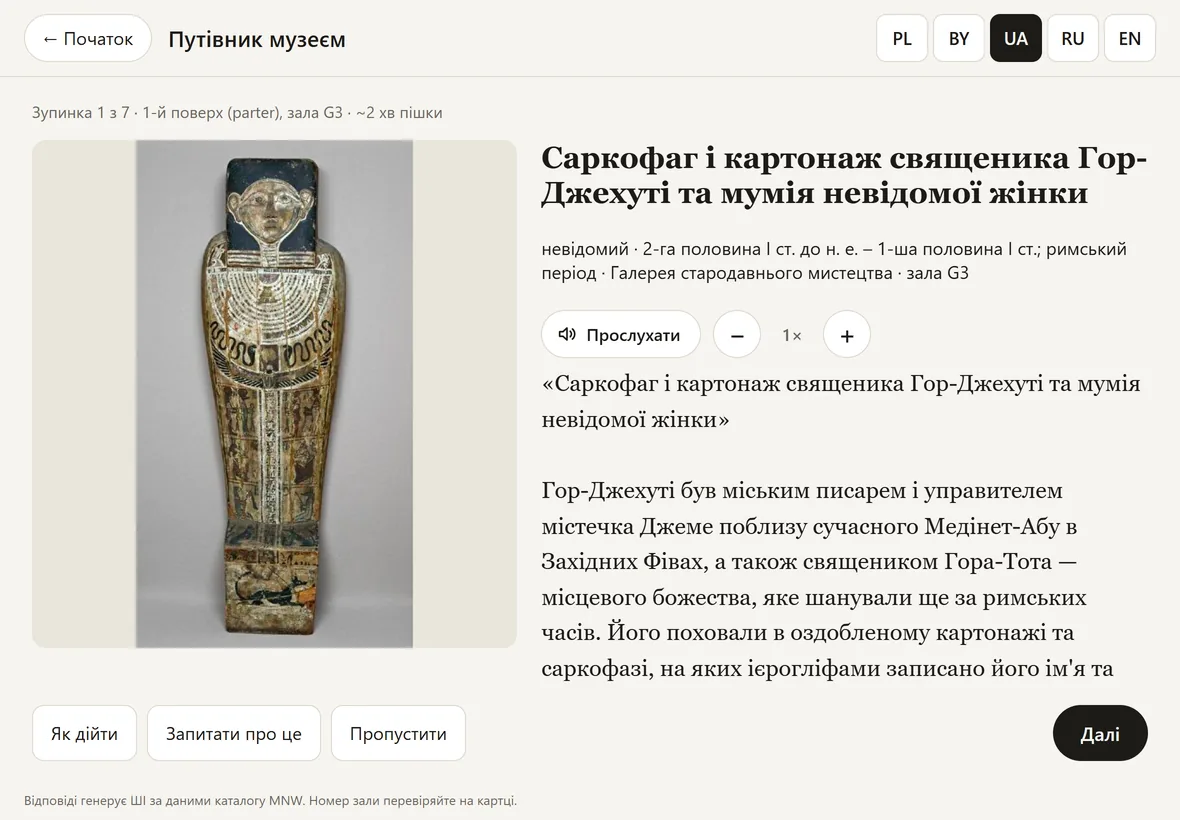
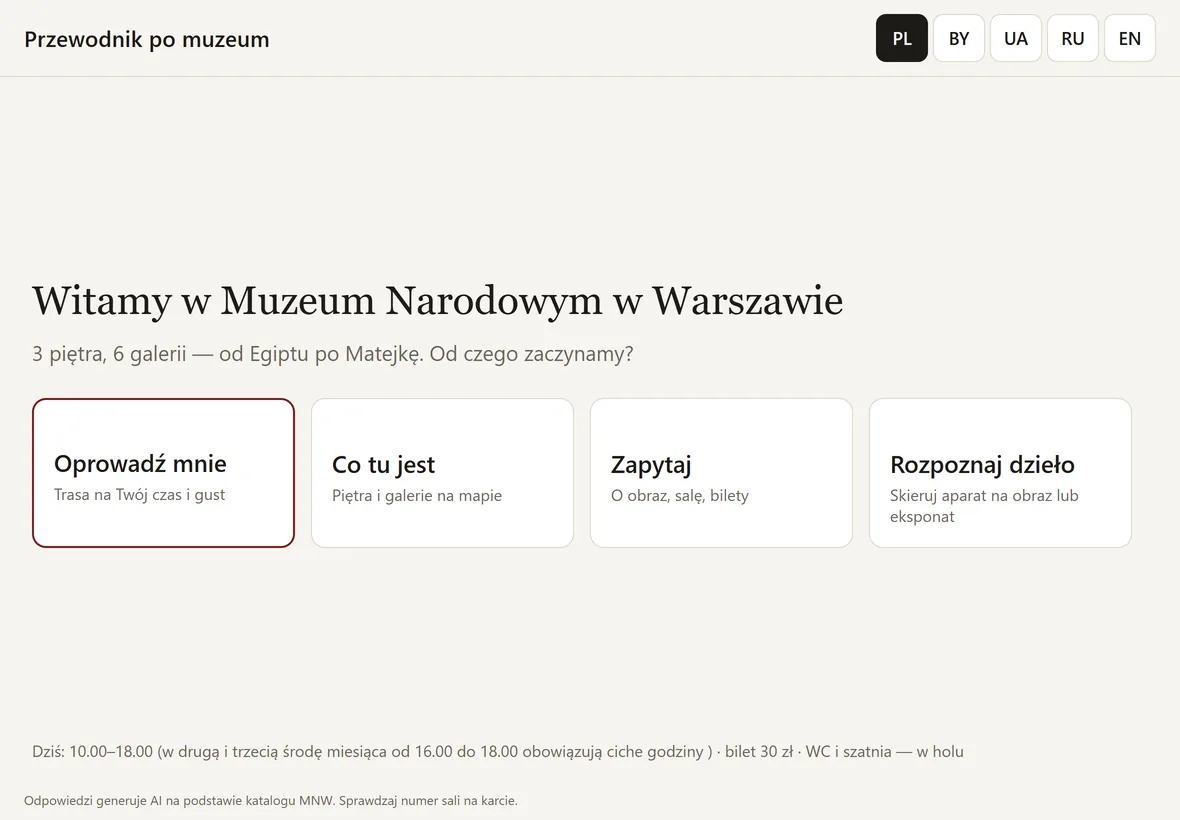
Demo: a guide to the National Museum in Warsaw, built on public data
I built it in a few days from the publicly available data of the museum's digital collection, to show how this kind of search works on a real catalogue. It's my own demonstration project, not commissioned by the museum or made in cooperation with it. It runs on tablets and phones: catalogue, questions by text and voice, floor maps, guided routes.
Example questions
- Gdzie wisi Stańczyk?
- Gdzie jest Bitwa pod Grunwaldem?
- Opowiedz o Galerii Faras
- Co warto zobaczyć w godzinę?
- Godziny i bilety
The demo is private. I'll show it live on a call, or give you access on request.
Questions
Common questions
Do we have to change our catalogue system?
No. The search runs next to your existing catalogue or digital library and links back to its records. All it needs is OAI-PMH, an API or an export.
Our metadata is incomplete. Is that a problem?
That's the usual case. Semantic search copes with short and uneven descriptions, and the report shows which additions would improve results most.
Do we need a tender?
With an estimated contract value below PLN 130,000 net, the Pzp law does not apply. Your internal procurement rules decide the procedure.
What if the pilot doesn't work out?
The pilot is paid in full and ends after four weeks. You keep the report and its findings, with no subscription commitment.
Won't the AI make things up?
The search only returns records that exist in your collection. Descriptive answers are optional and can contain inaccuracies, so they always point to the source records.
Who runs this?
Pavel Novikau, an independent engineer in Warsaw (sole proprietorship). I design and run search systems over archive collections on my own infrastructure.
I'll build a demo on your data.
Send me the name of your institution and the address of your online collection. I reply within two working days, and build a demo on your public data free of charge, with no commitment.
Or write directly: